This is a perfect example of how globalization has affected music. Internationally, artists are able to collaborate and communicate to build transnational cultures that ignore traditional geographic and cultural boundaries. I created this blog to shed some light on this subject, and particularly in the realm of hip-hop.
Hip-hop is a relatively new idea for most of the world. Hip-hop is a musical movement, but it’s also more than that; hip-hop is a culture. It exploded out of New York in the late 1970’s, and took the United States by storm. Hip-hop culture is based around MCing (rapping), DJing, b-boying (break-dancing and graffiti. These art forms were practiced and advanced by incredibly dedicated young people, who used hip-hop as a means of escaping the daily struggle. According to hip-hop pioneer Afrika Bambaataa, its roots include “funk, soul, rhythm & blues, jazz, rock heavy metal, salsa, soca (calypso), TV shows, kiddie shows, horror movies, techno, pop, disco, african, arabic, reggae,” just to name a few. So a form of music, indeed a culture that blends so many others, was bound to go looking for its roots someday, and that’s where international hip-hop comes in. Around the world, there are movements springing up that mirror the 1970’s Bronx, and young people are creating hip-hop cultures of their own.
I created this blog to follow the experiences of fans, artists, filmmakers and writers involved in hip-hop around the world, as well as share some experiences of my own.
At the very least this blog will teach you something about international hip-hop you never knew. However I hope it will do more than that. I want to point out some notable things about international hip-hop, its contradictions and successes. And by the time you're finished reading this, I hope you will be able to feel the incredible amount of enthusiasm, spirit and drive that international hip-hop and all its participants have to offer.

Heavy Metal Islam

My first foray into the arena of international hip-hop came when I read the book Heavy Metal Islam- Rock, Resistance and the Struggle for the Soul of Islam for an Anthropology class. The book is a travelogue of sorts, written by heavy metal musician and Middle Eastern history professor Mark LeVine. The title alone was enough to draw me in, but the stories I found inside provided a unique, first hand perspective of hip-hop in a different country that I had never seen before.
Now despite being a white kid from the suburbs of Washington D.C., I've always loved hip-hop. When I first discovered the genre, I was fascinated by the way artists sampled and blended different bits and pieces of music together to create a mélange of music. I was a big fan of all kinds of hip-hop, and I even hosted my own radio show freshman year for two hours every Friday. So when I read Heavy Metal Islam, LeVine's description of the ways that artists communicate and collaborate in the Middle East amazed me.
“Our whole life is inside,” describes a musician from a popular Iranian metal band, “Inside you don’t need to wear your veil, you can blast your music, dance… and otherwise feel free" (176). This is a common sentiment among artists. In Iran, musicians are restricted mostly by the Islamic government. All music must be approved by the Ministry of Culture, which screens for anything from rebellious lyrics to guitar riffs that are just a bit too edgy. Cassette tapes, which were banned by Khomeni after the Iranian revolution, are bought and sold by fans like illegal drugs. Public concerts are regularly shut down and heavy metal artists are reduced to playing “metal theatre,” where patrons must be seated, and cannot headbang or dance. So in repressive cultures like this, how do artists collaborate to put out decent music, and create communities where they can share this music and their culture? One word: Internet
"Hanging around the internet has become the equivalent of hanging out on the street corner,” LeVine declares (18). And it’s true, the internet has proliferated most countries in the Middle East to the extent where almost any city dweller can afford an hour at an internet café to link up and share information across national and cultural boundaries. Indeed, the very existence of LeVine’s text owes thanks to the internet, without which he would have never met all the musicians and politicians that he did. He met Reda Zine, one of the most influential figures in Heavy Metal Islam, through the internet. In LeVine’s own words, “It was just a matter of time before [they] went from chat rooms to rehearsal rooms, the recording booth, and ultimately to sharing the stage” (25). What is even more important is when the power of the internet to unite people goes beyond these transnational bridges, and establishes local bonds. People who live under oppressive governments, where finding a public space to perform and share non-traditional music is difficult, have turned to the internet to create local communities based around musical movements. The web magazine Tehran Avenue has succeeded in creating a “means of bringing the vibrant underground scene of Tehran aboveground” (192). The magazine hosts regular web based music competitions where local artists can share and discuss their music. This allows musicians and fans who would otherwise be oblivious of each other a chance to communicate and establish a common community. These communities are even beginning to gain the courage to speak out against the government. LeVine talks extensively about the flourishing blogger scene in Egypt, and how it has become one of the primary outlets for activists who want to voice their opinion. They are even training other activists in technical matters and blogging techniques. The members-only metal community metalgigsforum.com (no longer exists) is another place where artists and fans alike can speak out about politics with lessened fear of government backlash. The ability to have anonymity on the internet and garner widespread report even allowed the web site Marock Sans Frontiers (Morocco without Borders) to post an open letter challenging the Moroccan King, which is a definite no-no in Morocco. The internet has provided a ground-breaking forum for citizens to assemble and create public communities, complete with a public group identity.
In Egypt an artist’s popularity is heavily dependent on their MySpace page. In Lebanon, the rap duo Soap Kills has chosen to distribute their music online to avoid corporate restrictions and reach a broader audience. In Iran, rapper Peyman-Chet uploads his raps to the internet to be downloaded by thousands of people worldwide. Does any of this sound familiar? It should, because all over the world musicians are using the internet to disseminate their music and create virtual communities. Here in the United States, the artist Girl Talk and the band Radiohead both chose to release their most recent albums online for free. Hip hop in America is heavily reliant on mix tape sites like datpiff.com where artists, beat makers, DJs and lyricists can collaborate across the world. The internet is one of the musician’s greatest tools, and it allows music to travel to places where it can attract brand new audiences and bring people together despite cultural boundaries. Slowly, cultural revolution is coming to countries which are in desperate need of change. Iranian rappers are beginning to reclaim public space through internet advertised rap battles in the park. Young people are traveling through the cities of the Middle East blasting hip hop and heavy metal they downloaded off the internet through their car speakers and iPods, while tagging their favorite artists’ names on the walls of the subways and buildings. Hopefully, if the movement continues, the internet will allow those people in the Middle East who have been forced to build online societies to enact real change, and eventually, bring their public, group identities back into the real world.
I Love Hip Hop in Morocco

Pretty soon after reading Heavy Metal Islam, I found out that director Joshua Asen was coming to Lehigh to show his documentary I Love Hip Hop in Morocco. Josh got a Fullbright scholarship to travel to Morocco and document the emerging hip-hop movement there, as well as help put on the country's first hip-hop festival. The film follows Josh throughout Morocco, as he and his co-director Jennifer Needleman bring together performers, producers, and equipment to show Morocco its first festival centered around the hip-hop culture. In short, the movie was inspiring.
The film follows several artists who are participating in the festival. The most well known in Morocco are MC Bigg, H-Kayne, and Fnaire, and each has made quite a name for themselves since the release of the movie. However, the artist I found the most interesting was FatiShow, a teenage girl from Meknes Morocco who raps alongside MC Bougha in the duo Mot de Passe. In the film, Joshua tries to give a little insight into the lives of each artist, going around their hometown, seeing how they put their music together, and interviewing their friends and family. Fati's life seemed the most normal out of all the artists, yet she was definitely the most remarkable. Her parents are interviewed, and they share their trepidation about their daughter's initial entry into Moroccan hip-hop culture. But their attitude seems familiar, if not almost American, and they tell Fati that she can perform at the festival only if her final grades are sufficient. Fast-forward to the end of the movie, where we see Mot de Passe take the stage for the very first time. The crowd, which is almost exclusively male, has come to see H-Kayne and Bigg. FatiShow walks onto the stage and is greeted by a booing crowd. Her voice can hardly even be heard over the jeers, but she takes the microphone with a smile. "Is everyone alright?" Fati asks, completely aware that everyone is against her. Her attitude is the epitome of confidence, and she says something to the effect of "I don't care what you think, I'm just here to rap." What follows is definitely the highlight of the movie: the beat drops, and FatiShow begins to rhyme so fluidly, so smoothly that the entire crowd explodes. Boos turn to cheers, and just like that, all of Fati's hard work and love for the culture is validated. "She killed it," Joshua told us, "we couldn't make that up." The moment was so dramatic, it even caught the attention of the mainstream media:
FatiShow's performance demonstrates the incredible power that music has to subvert culture. In Morocco, where culture is completely male-dominated, all it took was one artist to blow that out of the water. And while FatiShow is nowhere near a hip-hop superstar, she is enjoying a bit of fame as a result of the film, with a growing online fan-base. Her blog, where she releases all of her new songs, can be found at fatishow.skyrock.com (in Moroccan Arabic).
The whole movie struck a chord with me. As I was watching, I felt that if someone had gone back in time to 1970's New York and given a camera to Clive Campbell, we would see the exact same thing. Artists with a passion for their music, who used all the resources available to them to establish a hip-hop community. It really felt like I was watching the birth of a movement, and not just a film about hip-hop.
However, things are not always what they seem. Later, discussing the movie with Joshua, I discovered that the festival and its participants were not as motivated as they seemed, and that the entire operation wasn't nearly as grass-roots as it appeared. The entire festival would not have been possible without a generous grant from the American embassy in Morocco, and the lucrative sponsorship of Sprite. In addition, I found out from Joshua that he ended up doing most of the work in organizing the festival, and at times it was a struggle to engage the artists. According to Joshua, many of the artists were guilty of a false sense of entitlement. Their experiences with hip-hop had all occurred as fans of American hip-hop, and in their eyes, American hip-hop stars just put out music, nothing more. The artists saw their role as strictly musicians, not community organizers, and they didn't see why they should have to both perform and organize. Instead of helping hang up promotional posters, they complained that their name was listed second even though they were obviously more popular than so-and-so. The movie seemed to be rooted in the local, but after speaking with the director firsthand, its obvious that Western influences played a crucial role. The romantic vision of a community coming together to share in their passion is somewhat spoiled when you learn that it was sponsored by Sprite, organized by a white ivy league graduate, and the passionate artists who were supposedly "in it for the music" had adopted the attitude of American prima donnas. It all makes me wonder, if the story had occurred the way it was depicted, would I ever have found out about it?
Trinity International Hip Hop Festival- Part One
By this point, I was hooked on international hip-hop. I'm a Global Studies student, and I love hip-hop, so it seemed like it was meant for me. Also, I Love Hip Hop in Morocco introduced me to the idea that there are people out there who are getting paid to go overseas and listen to incredible music. Sounds like a great time right? So I typed the phrase "international hip-hop" into google, and right there at the top of the results was the Trinity International Hip Hop Festival. An annual event, the Trinity festival brings together MC's, DJ's and B-Boys from all over the world to Trinity College in Hartford Connecticut.
This was exactly the thing I was searching for. Hartford is only 5 hours away from the school I go to, Lehigh, and even though I had never heard of any of the concert's participants, it seemed like it would be a great time for a student of global studies and a fan of hip-hop. So I started making plans, which began with registration.
The Trinity festival is free, but you have to register to attend, so I signed up on the site with my @lehigh.edu email address. Then I started thinking, since international hip-hop was so closely linked with all the things I was studying, how could I take advantage of this? I had two final projects for two separate global studies classes, and they both gave the option of submitting a film, rather than doing a research paper. This was when I had what I thought was the best idea ever- make a documentary. I mean, it couldn't be that hard right? I had made plenty of movies in high school with a friend who now goes to film school at NYU, so I knew how to point a camera and do some basic editing. And Lehigh had camera and editing equipment available for any student to borrow. So I figured I could just go to the festival, film everything I saw, and edit it together into an awesome movie instead of spending hours sitting in the library writing a research paper. What could go wrong? (Apparently, a lot, but I'll get to that later)
After that, I shot off a message to Joshua Asen, the director of I Love Hip Hop In Morocco, to ask for advice.
This was great, Josh made it sound like making a movie was a walk in the park. So all I had to do now was get the equipment from Lehigh and find somewhere to stay while I was in Hartford. That was when I started talking to Greg.
Greg Schick is the PR coordinator for the Trinity festival, and he also runs a website dedicated to global hip hop. He first emailed me after seeing my @lehigh.edu address in the festival registration to ask if I had been involved in El Proyecto, a Cuban hip-hop festival that Lehigh threw in April 2008. I hadn't been, but we started talking, and I told Greg how I was planning on filming at the Trinity festival this year.
This was awesome! I had never done anything like this before, but I was already set up to get my own press pass! Okay so I'll be the first to admit that I may have been a little naïve, but I thought they only gave press passes to real journalists, not just students with a camera, so I was ecstatic. In just a few short weeks I had gotten advice from the director of I Love Hip Hop in Morocco, met a website owner and influential person in international hip-hop, and scored a press pass. Either this community was a lot smaller than I originally thought, or I had had an incredible streak of good luck. I made the arrangements to borrow camera equipment from Lehigh, and booked a bed at the cheapest hostel in Hartford, completely confident that I would return to Lehigh at the end of the weekend with a movie in hand. I can tell you now, in hindsight, that I had no idea what I was getting myself into.
This was exactly the thing I was searching for. Hartford is only 5 hours away from the school I go to, Lehigh, and even though I had never heard of any of the concert's participants, it seemed like it would be a great time for a student of global studies and a fan of hip-hop. So I started making plans, which began with registration.
The Trinity festival is free, but you have to register to attend, so I signed up on the site with my @lehigh.edu email address. Then I started thinking, since international hip-hop was so closely linked with all the things I was studying, how could I take advantage of this? I had two final projects for two separate global studies classes, and they both gave the option of submitting a film, rather than doing a research paper. This was when I had what I thought was the best idea ever- make a documentary. I mean, it couldn't be that hard right? I had made plenty of movies in high school with a friend who now goes to film school at NYU, so I knew how to point a camera and do some basic editing. And Lehigh had camera and editing equipment available for any student to borrow. So I figured I could just go to the festival, film everything I saw, and edit it together into an awesome movie instead of spending hours sitting in the library writing a research paper. What could go wrong? (Apparently, a lot, but I'll get to that later)
After that, I shot off a message to Joshua Asen, the director of I Love Hip Hop In Morocco, to ask for advice.
Me:
"Do you have any tips for getting solid, reliable footage of the actual performance? I'm only going to have one camera and a shotgun mic, and I plan on bringing enough tapes and batteries to film for the duration, but I'm relatively inexperienced when it comes to this kind of thing. Any advice on what not to do would probably be even helpful too."
Josh:
"No problem. The best advice I can give is to bring a tripod (or find a stable place to shoot) and make sure you're in focus and your mic levels are good. Then, just ask good questions. You'll definitely get some good footage. Just keep rolling.
Good luck
J"
This was great, Josh made it sound like making a movie was a walk in the park. So all I had to do now was get the equipment from Lehigh and find somewhere to stay while I was in Hartford. That was when I started talking to Greg.
Greg Schick is the PR coordinator for the Trinity festival, and he also runs a website dedicated to global hip hop. He first emailed me after seeing my @lehigh.edu address in the festival registration to ask if I had been involved in El Proyecto, a Cuban hip-hop festival that Lehigh threw in April 2008. I hadn't been, but we started talking, and I told Greg how I was planning on filming at the Trinity festival this year.
Greg:
"Yo man, it’s your lucky day. Check out these guidelines for filming at the festival:
- For any footage you put out – online or otherwise - the Trinity flier logo and sponsors’ logos will be displayed at the start of the video (we will provide those).
- During any artist performance video clips, the artist’s web address will be displayed at the bottom.
- A copy of all film will be provided to us for use in promotions.
When you check in at the festival, you will sign a short agreement to the above conditions. In return, you will get a press pass, permission to film and produce pieces with your film.
So I can get you a press pass. What do you think about that? I already put you on the list."
This was awesome! I had never done anything like this before, but I was already set up to get my own press pass! Okay so I'll be the first to admit that I may have been a little naïve, but I thought they only gave press passes to real journalists, not just students with a camera, so I was ecstatic. In just a few short weeks I had gotten advice from the director of I Love Hip Hop in Morocco, met a website owner and influential person in international hip-hop, and scored a press pass. Either this community was a lot smaller than I originally thought, or I had had an incredible streak of good luck. I made the arrangements to borrow camera equipment from Lehigh, and booked a bed at the cheapest hostel in Hartford, completely confident that I would return to Lehigh at the end of the weekend with a movie in hand. I can tell you now, in hindsight, that I had no idea what I was getting myself into.
Trinity International Hip Hop Festival Part Two: Poetic Pilgrimage
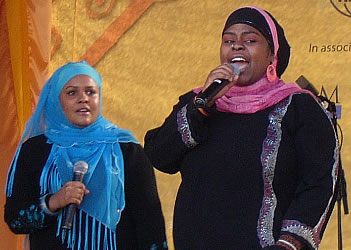
Fast forward to April 3rd, the first day of the Trinity festival. I woke up before the sun (which, for a college student, is a feat all in itself), got in my car and set off on the five hour drive to Hartford. Due to traffic, I showed up at 10:20, 20 minutes late to the first event of the day, a discussion on hip-hop, Islam and gender with the duo Poetic Pilgrimage. It was set up in a classroom, and it seemed that I was the only attendee who wasn't in the class. I didn't have time to set up a camera, so I snuck to a desk to listen to what Poetic Pilgrimage had to say. Poetic Pilgrimage is made up of two women from Bristol, England, Muneera Rashida and Sukina Abdul Noor. Both women have Jamaican roots, and both are converts to Islam. They made a name for themselves on the London poetry circuit, and they "have become one of the most well-known and well-respected Muslim hip hop crews in the world," according to Greg Schick.
Here's a video of their song Definition of a Pilgrim:
Muneera and Sukina only spoke for about 50 minutes, and I missed the first 20, but I did learn what hip-hop means to them in the short bits I did see. They spent most of the time talking about how once they converted to Islam and became involved in the hip-hop community, they felt immediately a part of a global culture. "All of a sudden, Islam's problems were my problems," Muneera said, and their music and spoken word poetry was influenced by this feeling of inclusion. Sukina also talked about wearing a hijab, the head covering traditionally worn by Muslim women, and how it opened her eyes to the gender stereotypes and inequalities that many Muslim women face. Poetic Pilgrimage then performed a short spoken-word piece, which talked about the problems Islam faces around the world, including homosexual discrimination. What I gathered from watching the presentation was that both of these women identified themselves with larger global communities. They felt that they were women, Jamaican, English, Muslim and hip-hop artists, and by identifying themselves in these ways, they included themselves in each of these global communities.
Trinity International Hip Hop Festival Part Two: Fullbright Scholar Angela Steele
After this, it was only a short walk down the hall to another classroom to listen to Angela Steele, a Fullbright scholar, present the research she did on a trip to China, following the emerging hip-hop movements in that country. I was particularly excited to talk to Angela because her experiences mirrored those of Joshua Asen, only in a very different country. The classroom was very small, and it again appeared that I was the only attendee who wasn't part of the class. I was able to set up a camera in the back of the room, and I started filming as soon as Angela started speaking... in Chinese. I started panicking, thinking I had misread the schedule or something, but the teacher eventually stopped Angela to tell her that the class was a beginners Chinese class, and her speech would probably be much more effective if she gave it in English.
So once I could actually understand the presentation, I was fascinated by Angela's account of Chinese hip-hop. I combined the highlights of the presentation into a video clip (including the awkward beginning), and although the film quality isn't too great, the audio comes through well:
I chose these highlights because they were the things that struck me as most interesting in regards to Chinese hip-hop. Rather than being driven by individual artists and communities, like in Morocco, the culture of hip-hop in China is drive by corporations and industry. Nike and the NBA have had a very strong influence in bringing hip-hop culture into China, and although fans get their music through mediums like Dakou cds and the internet, their culture is imported by Western transnational corporations. This is typical Americanization, with globalization occurring from above and being driven by corporations, and it dominates over the local culture.
To find out more about Angela Steele and her Fullbright research, you can check out her website, and her youtube page has plenty of great videos with plenty of artist interviews that provide insight into the spread of hip-hop in China.
Trinity International Hip Hop Festival Part Two: FangAfrika Movie Screening

After Angela Steele's presentation, there was a long break in the festival schedule. So I drove across town to the Mark Twain hostel and made sure I still had a room, then returned to Trinity in time for the screening of FangAfrika. FANGAFRIKA: La Voix des Sans-voix (The voice of the voiceless) is a documentary about the emerging West African hip-hop scene made by French filmmakers Guillaume Mouille and Renaud Lioult. The film was shown with English subtitles, and it follows various artists around West Africa leading up to the Ouagadougou hip-hop festival, which brings together Africa's best hip-hop stars once a year for a week long celebration of hip-hop culture.
Both directors of the film were on hand with Senegal artist Baay Musa for a question and answer session after the screening, and I had my camera set up to capture it. However, there were no microphones in use, so my camera couldn't pick up their voices as they spoke, but I did take away a few insights from the movie and the discussion. What struck me as the most fascinating about hip-hop in Africa were the reasons that artists chose hip-hop over other forms of music. To rap, all you need is a beat and a voice, the genre doesn't require expensive musical instruments or amplifiers. The closing credits of the movie exemplify this fact, as they show a group of West Africans sitting around a fire with a gourd. One man tapped out a rhythm lightly on the gourd, and each person took their turn laying lyrics on top of it. This scene demonstrated, more than any other scene in the movie, how the accessibility of hip-hop has broadened its appeal to anyone with access to a pad of paper and a pen.
There was one point in the discussion that also caught my attention. One of the chief organizers of the Trinity festival, alumni Magee McIlvaine, told the filmmakers how the design for the Trinity posters was inspired by the design of the posters for the Ouaga festival. The directors began to laugh, and they told Magee that they were actually the ones responsible for the design of the Ouaga posters. This demonstrated several things to me: First, globalization has allowed tight knit communities to form without regards to time or space, meaning that the Trinity organizers were very familiar with the Ouaga festival and its promotion. Second, and perhaps more importantly, it seems that like with Joshua Asen in Morocco, the motivating actors in these grass-roots movements do not come from the places they are trying to represent. Even though the Ouaga film festival is a celebration of West African hip-hop culture, it is only made possible with the influence of Americans and Europeans. Like with I Love Hip Hop in Morocco, after this film, I found myself wondering how honest FangAfrika's romantic depiction of African hip-hop really was.
Subscribe to:
Posts (Atom)